Showing posts with label Art. Show all posts

Tuesday, July 8, 2014

Fabian Marti's 'Two Hotel' Artists Guest House


"The idea of a hotel as a creative act is inspired by Alighero Boetti‘s One Hotel which he maintained in Kabul in the Sixties. However TwoHOTEL has a different focus as it is specifically aimed as a hotel for artists."

Images and full article at Centre for the Aesthetic Revolution


Friday, July 4, 2014

Mobile Office

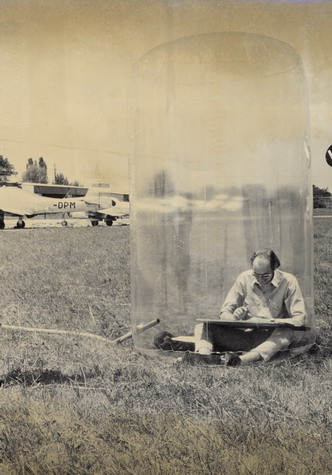
Hans Hollein, Mobiles Büro / Mobile Office, 1969

"1969, lange bevor die mobile Kommunikation ihre Möglichkeiten entfaltet hatte, propagierte Hollein ein aufblasbares Büro, dass temporäres arbeiten an den verschiedensten Plätzen ermöglichen sollte. In der Abbildung zu sehen: Hans Hollein beim Zwischenstopp mit Reißbrett und Telefon am Flugfeld Asparn"

Image and text via hollein.com

Wednesday, June 11, 2014

Plans (which aren't really plans)


Images from the top:
Ellsworth Kelly, One Stroke 1959 (via artspotting)
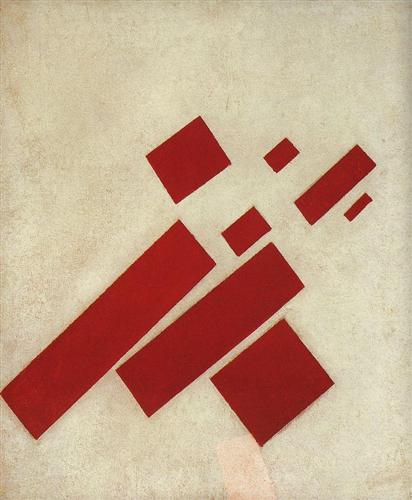
Kazimir Malevich, Suprematism With Eight Rectangles 1915 (via wikiart)
Gregory Crewdson, Untitled, from hover series, 1996 (via bombmagazine)
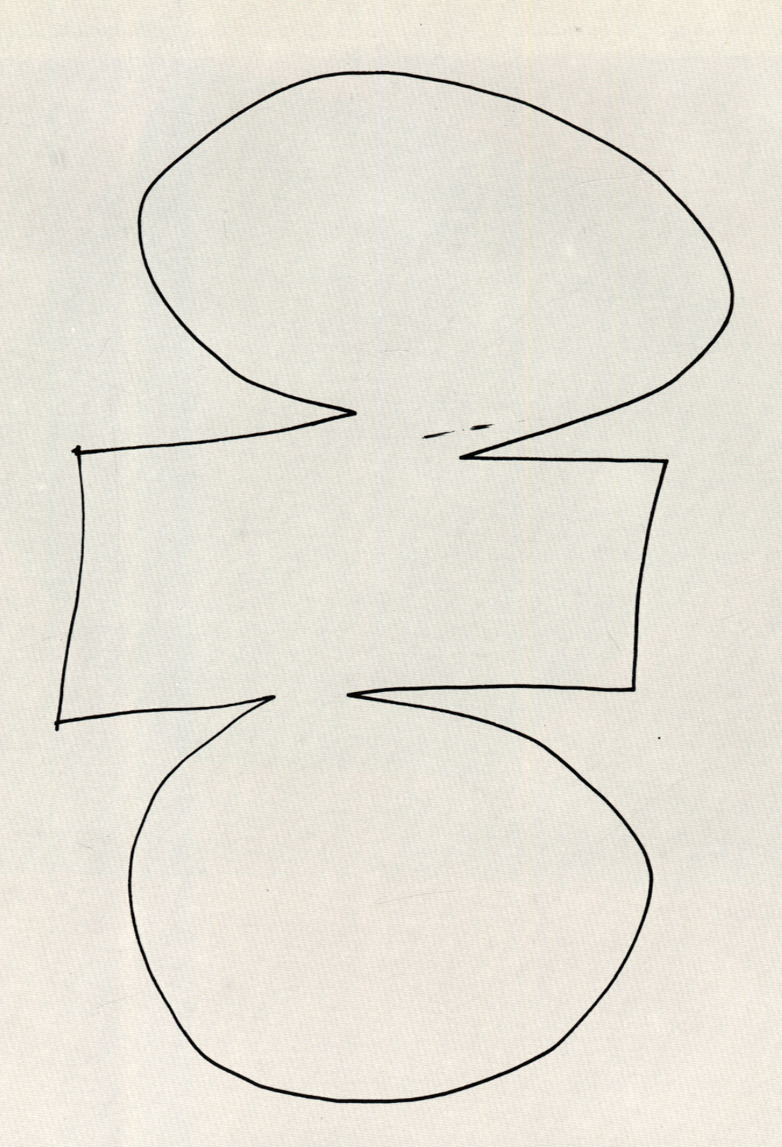
Louise Bourgeois, Untitled (Big Dipper), state I (via moma.org)
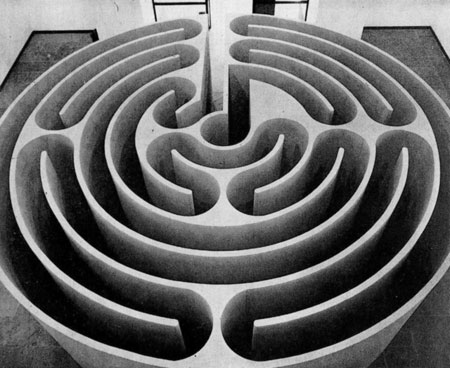
Robert Morris, Philadelphia Labyrinth 1974 (via wikiart)

Friday, May 16, 2014

Carl Andre and Definition of Space


Carl Andre: (From the top) 
Secant, 1977
Steel Magnesium Plain, 1969
Installing Steel Magnesium Plain, 1969


Monday, April 28, 2014

Andrea Zittel: Investigating freedom


Andrea Zittel
Image 1-3 from top: Inhabitable sculptures – A-Z wagon stations
Bottom: A-Z Carpet Furniture: Cabin

"Blurring the line between art and life, american artist Andrea Zittel’s fascinating experiments in functional living showcase her preoccupation with self-sufficiency and adaptability. Since a decade she has been creating minimal self-sufficient dwelling spaces in which everyday actions such as sleeping, eating, cooking, bathing and socializing are transformed into acts of art."

Text from www.designboom.com Follow the link to read the full article.
Images via www.designboom.comwww.artnet.com and www.afterall.org

Tuesday, April 8, 2014

Josef Albers: Structural Constellations


Josef Albers
F.M.E 5, 1962
Structural Constellation, ca. 1950
Structural Indication, 1948
All: Machine engraving on laminated plastic

Josef Albers is one of those great Bauhaus Artists I rediscover from time to time. We recently used som of his color exercises in a drawing class where I teach, and during research, I found the wonderful website albersfoundation.org They not only have great photos, but texts, lectures, and films with Josef and Annie Albers. A great resource, highly recommended!

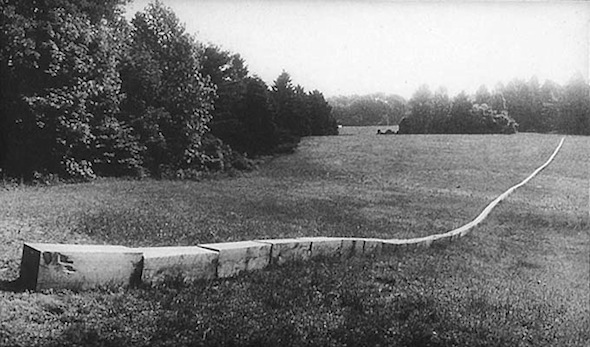
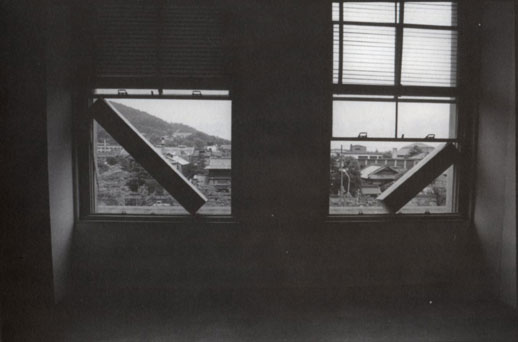
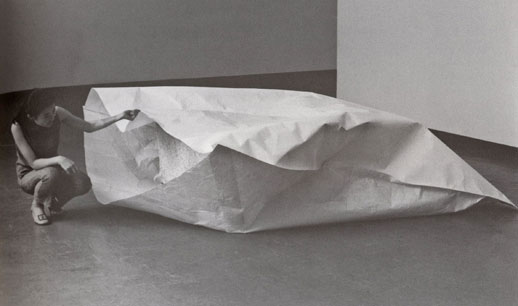
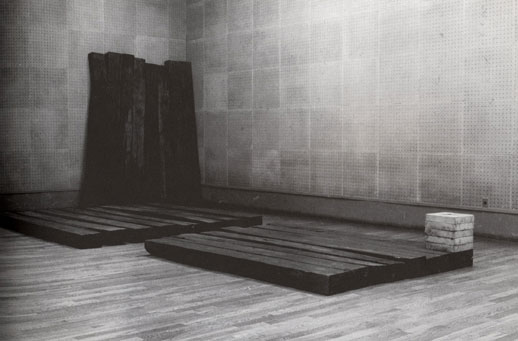
Mono-ha


From the top:
Nobuo Sekine Phase-Mother Earth 1968
Lee Ufan Relatum 1968
Kishio Suga Limitless Condition 1971
Susumu Koshimizu Paper 1969
Noboru Takayama Yuusatsu 1973

Mono-ha was a japanese art movement in the sixties and seventies, related to concept and minimal art. They investigated the material as a thing in itself, how it lies, stands or just is, and how it relates to other materials and the surrounding space. 

(Photos via www.tokyoartbeat.com, there you can also find out more abuot Mono-ha)

Saturday, April 5, 2014

Unfolded origami III: Gerd Tinglum

My former professor in art school, made these beautiful works:


Gerd Tinglum
Guards 1991
Pigment and lacquer on paper

Unfolded origami II: Dorothea Rockburne


Dorothea Rockburne 
Locus, 1972
Relief etchings with aquatints on folded paper

Conservation Class #9 1973 
Graphite on paper mounted on gessoed masonite

Copal VIII  1978
Kraft paper, Copal oil varnish, blue pencil, Mylar tape and glue on ragboard

Golden Section Painting: Square Separated by Parallellogram 1974
Gesso and blue pencil on sized, glued, and folded linen

More on Dorothea Rockburne: www.dorothearockburne.com

Unfolded origami I: Dóra Maurer

I absolutely love these unfolded-origami-ish works. Poetic geometry! Great minds think alike: I'll post works by three great artists this weekend. First up ...


Dóra Maurer 
Hidden Structures 1,2 and 6 1977-1980
Graphite on paper

Images via moma.org


Friday, April 4, 2014

Imi Knoebel: Raum 19


Imi Knoebel
Raum 19 (Room 19) 1968
Masonite, wood, multipart work

‘Room 19' from 1968 - (is) a large installation in four parts made of wood, in which Knoebel first introduced a core principle of his work: the principle of layering individual elements which then combine in ever new variations, in pictures and spatial compositions.

Images via wouter davidts archive
Text/image at the top via artnews

Dóra Maurer Tracing Space


Dóra Maurer 
Tracing Space I, Tracing Space II, and Plan 1979
Gelatin silver prints and graphite

Since the 1970s, Maurer has explored the nature of space and movement though the use of serial sequences of images, signs, and language. Working in photography, film, and graphic design, she makes art based on mathematical and conceptual processes, often reversing, repeating, and repositioning objects for the camera. In Tracing Space I, II and Plan, the artist applied this serial process of observation to her studio, moving around the space while photographing it. The pictures, presented with her plan for taking them, reveal the connection between structure (or intent) and spontaneity (what the camera actually recorded). Maurer’s process–oriented oeuvre unites the concrete and the conceptual in a manner that suggests the centrality of perspective—in art, as in life.

Text from moma.org


Monday, March 31, 2014

Space defining drawing

Some more or less abstract space defining drawings for you: 

Robert Maki, Obsidian, 1985

David Hockney

Richard Aldrich

Zbigniew Warpechowski - Drawing in the Corner, 1971

Foto: Ramón Masats - Tomelloso, Ciudad Real, 1960  

Sunday, March 30, 2014

Christine Sun Kim at MOMA


Cristine Sun Kim
All.Day. 2012
Ink, pastel and charcoal on paper

I saw this piece on MOMA in NY this fall, as part of an exhibit about sound art. Here is a text wich followed the artwork:

"In her series Scores and Transcripts, Sun Kim — who was born deaf—combines and transforms the various types of notation that chape her understanding and communication: among them American Sign Language, musical notation, English vernacular and body language. (...)
In All.Day. the artist has traced the path her hand would take to communicate the concept "all day" in American Sign Language—an arc that mirrors the movement of the sun. (...)"


Saturday, April 6, 2013

Michael Johansson, Familiar Abstractions

Exhibit at the Vigeland Museum. One of those times when you think "Crap, this is nice! I wish I had thought of doing this!". Johansson's sculptures are made of old furniture and other objects from our everyday life, reassembled or stacked on top of each other. Simple logic, but packed with references.


The Vigeland Museum, Oslo

My first blogpost is from this lovely saturday spent at the Vigeland Museum:


I'm a sucker for work in progress ...